
KYC in crypto means “Know Your Customer”. It is an identity check that many exchanges and wallet providers use before letting people buy, sell, or move funds. A typical KYC process asks for a legal name, date of birth, address, and a government-issued photo ID. Some platforms also request a selfie or proof of address to confirm the details. These checks aim to reduce fraud and meet anti-money laundering rules.
Key takeaways
- KYC in crypto means identity verification: Exchanges confirm a user’s legal name, date of birth, address, and government-issued ID, often adding a selfie or liveness test to reduce fraud and meet anti-money laundering (AML) rules.
- Regulation drives widespread adoption: Following guidance from the Financial Action Task Force (FATF), including the “travel rule,” most major exchanges now require KYC before allowing meaningful deposits, trading, or withdrawals.
- The process involves multiple checks: Users typically complete a form, upload ID and proof of address, and undergo authenticity, face-match, sanctions, and politically exposed person (PEP) screening before gaining full account access.
- Data collection and storage vary by platform type: Centralised exchanges store identity documents, biometrics, and compliance records—sometimes for years—while non-custodial wallets usually collect little or no personal data.
- KYC requirements depend on the service: Centralised exchanges and brokers generally require full verification, especially for fiat transfers, while DeFi on-ramps may apply lighter checks or transaction limits depending on whether they are custodial.
- There are clear trade-offs: KYC improves compliance, fraud monitoring, and account recovery options, but reduces privacy, increases data exposure risk, and can impose limits or delays for users who choose not to verify.
Definition of KYC in Crypto and Why Exchanges Use It
In 2023, the Financial Action Task Force (FATF) reported that 75 out of 135 jurisdictions assessed had implemented its “travel rule” for virtual assets, a core compliance measure tied to identity checks. That spread of regulation explains why most major crypto exchanges now require KYC before users can deposit, trade, or withdraw meaningful amounts.
KYC stands for “Know Your Customer”. In crypto, it means an exchange verifies a customer’s identity using documents and checks such as a passport or driving licence, a selfie or liveness test, and proof of address. Exchanges use KYC to reduce money laundering, fraud, and sanctions breaches, and to meet legal duties under anti-money laundering rules.
In the UK, KYC sits inside the Money Laundering Regulations 2017, which require customer due diligence for many financial services. The Financial Conduct Authority (FCA) also requires cryptoasset firms registered for AML supervision to apply risk-based controls, which commonly include identity verification and ongoing monitoring.
KYC does not guarantee safety, but it changes the risk profile by linking accounts to real identities and creating audit trails. For a wider view of consumer risk, see is crypto safe? what.
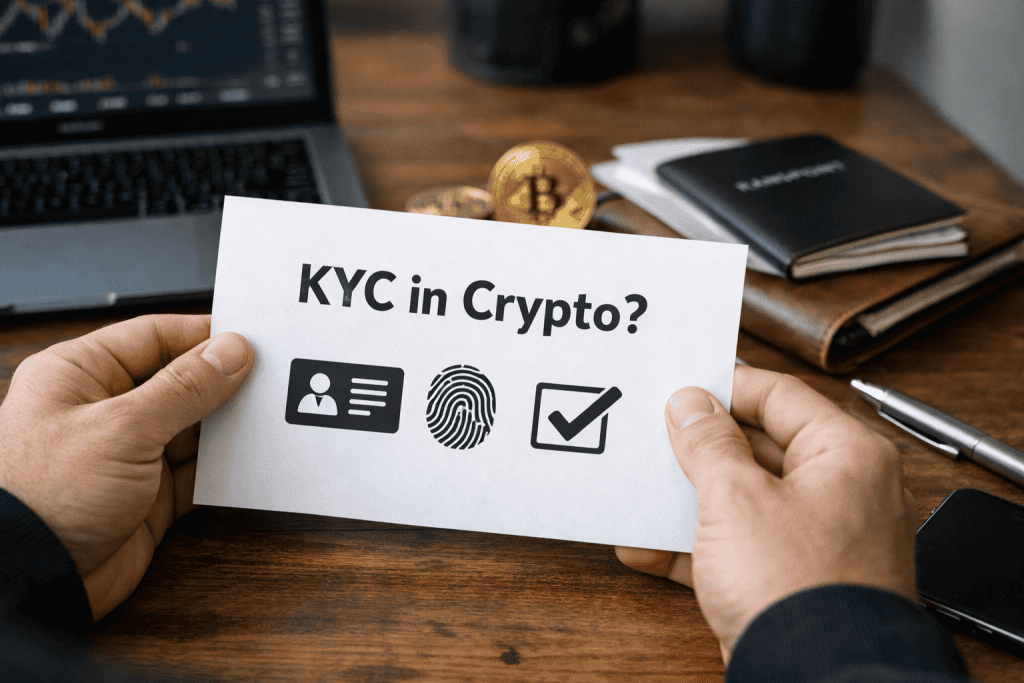
How the Crypto KYC Process Works: Steps, Documents, and Verification Checks
A new user opens an account on a major exchange and tries to withdraw funds. The platform pauses the withdrawal and asks for identity checks before it releases the transfer.
The process usually starts with a short form (legal name, date of birth, address). Next, the exchange requests documents such as a passport or driving licence, plus proof of address like a bank statement or utility bill. Many platforms also ask for a selfie or short video to confirm the person matches the ID and is present.
- Document capture: upload clear photos of ID and address evidence.
- Verification checks: authenticity checks, face match, and basic fraud screening.
- Risk screening: sanctions and politically exposed person (PEP) checks, aligned with guidance from FATF.
Once approved, the account can access higher limits and more features. If details change, exchanges may request an update to keep records current.
What Information KYC Collects and How It Is Stored and Shared
KYC on a centralised exchange collects personal identity data, while a non-custodial wallet typically collects none because no account is created. This difference affects what platforms store, share, and the risks users carry.
Under KYC, an exchange usually records legal name, date of birth, address, and government ID details. Many platforms also capture a selfie or short video for liveness checks, plus device and login metadata for fraud controls. Some services request a tax ID or source-of-funds details when activity triggers enhanced checks.
Exchanges store this data in internal compliance systems and with verification providers. Storage can include encrypted document copies and audit logs showing when checks were completed. Retention varies by jurisdiction, but regulated firms often keep records for years after account closure to meet anti-money laundering rules.
| Area | KYC exchange account | Non-custodial wallet |
|---|---|---|
| Data collected | Identity, address, ID images, biometrics, risk signals | Usually none beyond what the user shares |
| Storage | Compliance databases and vendors | On the user’s device or chosen backup |
| Sharing | May share with banks, vendors, and authorities | Limited unless a service provider is used |
Sharing usually involves verification vendors, banking partners, and regulators responding to lawful requests. Some transfers may also require “travel rule” messaging between service providers, as set by FATF. KYC can unlock higher limits and faster support, but it increases exposure to breaches and cross-border transfers.
KYC Requirements by Platform Type: Centralised Exchanges, Brokers, and DeFi On-Ramps
Users often hit a hard stop when a platform blocks deposits or withdrawals until identity checks clear. That delay can matter if prices move quickly or a user needs to move funds the same day.
The solution is to match your expectations to the platform type. Centralised exchanges and many brokers act as regulated intermediaries, so they usually require KYC before higher limits or fiat transfers. DeFi on-ramps vary: some run full KYC, while others only screen transactions and apply limits.
- Centralised exchanges (CEXs): expect full KYC for meaningful trading and withdrawals; complete verification before funding the account.
- Brokers: expect KYC at sign-up, especially for card or bank payments; confirm supported documents and countries first.
- DeFi on-ramps: check whether the service is custodial, whether fiat is involved, and whether limits change after verification.
Practical steps: review the platform’s “Verification” and “Limits” pages, prepare a valid photo ID plus proof of address, and submit checks during business hours. Results: fewer blocked transfers, clearer limits, and faster access to withdrawals when you need them.
Pros, Cons, and Alternatives: Privacy Trade-Offs, Limits Without KYC, and Compliance Options
In 2024, Chainalysis estimated illicit crypto transaction volume at $40.9 billion, up from $24.2 billion in 2023. That scale explains the main benefit of KYC: exchanges can screen users, flag risky activity, and meet legal duties that banks and payment firms already follow. KYC can also help account recovery, since platforms can match an account to verified identity details.
The trade-off is privacy. KYC creates a central record of identity documents, selfies, and device data, which can increase exposure if a platform suffers a breach or shares data under legal requests. KYC also adds friction: checks can delay access, and some users fail automated verification because of document quality or name mismatches.
Without KYC, limits usually tighten. Many services restrict fiat deposits, card buys, or withdrawals until verification completes, and some block higher-value transfers entirely. Users who avoid KYC often move to non-custodial wallets and decentralised exchanges, but those options shift responsibility to the user and can raise fraud risk. Reviewing common crypto scams in the UK helps set safer expectations when using less supervised routes.
Compliance-focused alternatives include “tiered” verification (basic checks for small limits, full KYC for higher limits) and regulated on-ramps that verify once, then reuse that status across services where permitted.
Frequently Asked Questions
What does KYC mean in cryptocurrency exchanges?
KYC means “Know Your Customer”. On cryptocurrency exchanges, it is an identity check used to confirm who a user is before allowing certain actions, such as buying crypto with fiat money or withdrawing larger amounts. Exchanges typically collect a government ID, a selfie or live check, and proof of address.
Why do crypto platforms require KYC verification before trading or withdrawals?
Crypto platforms require KYC to confirm a user’s identity and reduce fraud, account takeovers, and stolen-funds withdrawals. KYC also helps platforms meet anti-money laundering and counter-terrorist financing rules, which often apply before higher-value trading or withdrawals. This process can limit chargebacks, stop duplicate accounts, and support investigations when suspicious activity occurs.
What documents do you typically need to complete crypto KYC checks?
Crypto KYC checks typically ask for a government-issued photo ID (passport, driving licence, or national ID card) and proof of address (utility bill, bank statement, or council tax letter). Many platforms also require a selfie or short video to match the ID. Some may request your tax ID or source of funds details.
How long does KYC verification usually take on a crypto exchange?
KYC verification on a crypto exchange usually takes from a few minutes to 48 hours. Automated checks can approve clear documents quickly, while manual reviews take longer. Delays often happen when photos are blurry, details do not match, or the exchange needs extra checks for higher deposit or withdrawal limits.
Can you buy or trade cryptocurrency without completing KYC?
Yes, sometimes. Some decentralised exchanges (DEXs) let you trade using a self-custody wallet without KYC. Some centralised platforms also allow limited trading with basic checks, but usually restrict deposits, withdrawals, or higher volumes. Rules vary by country, and services can block access based on location.
How does KYC in crypto differ from AML checks and transaction monitoring?
KYC verifies a customer’s identity at onboarding using documents and basic risk data. AML checks screen that identity against sanctions, watchlists, and politically exposed person (PEP) lists, then apply risk rules. Transaction monitoring runs continuously after onboarding, analysing deposits, withdrawals, and trading patterns to flag suspicious activity and trigger reviews or reports.
What privacy and data security risks should you consider when submitting KYC for crypto?
Submitting KYC can expose you to identity theft if a platform suffers a breach. Risks include leaked passport or driving licence scans, selfies, proof of address, and bank details. Data may be shared with verification firms or stored in other countries, raising access and retention concerns. Phishing and fake “KYC update” emails can also steal documents.