
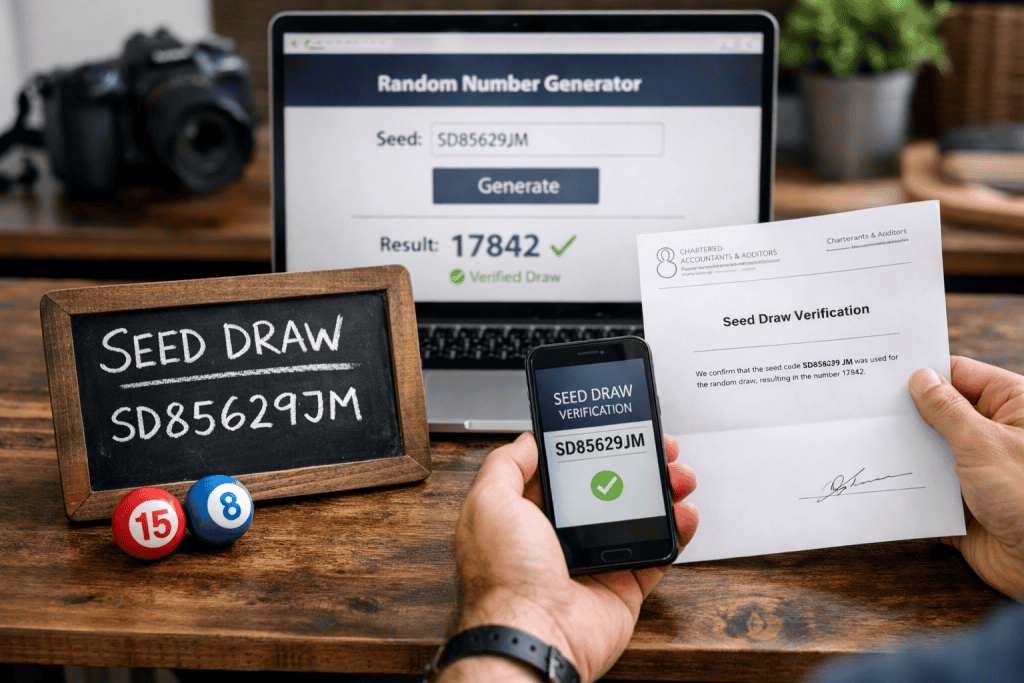
Seed draw verification is a transparency method used by UK competition websites to prove that winner selection is random and unmanipulated. It works by publishing a cryptographic seed value before entries close, making the draw outcome independently verifiable. This article examines how competition operators implement seed draws, what the verification process involves, and why regulators and entrants treat it as a credibility marker.
Key takeaways
- Check the published SHA-256 hash before entering any prize competition draw.
- A seed draw uses two stages: hash publication before sales close, seed release after.
- The timestamp on the hash proves the seed existed before any ticket was sold.
- Winners are selected using a deterministic modulo function applied to the seed value.
- Anyone can independently verify results by hashing the released seed and checking it matches.
- A hash mismatch after the draw means the seed was altered, invalidating the result.
- Cryptographic verification helps organisers demonstrate compliance under the Gambling Act 2005.
What a Seed Draw Verification Is and How It Works
Check the seed draw record before entering any prize competition online. A seed draw verification gives you cryptographic proof that a winner was selected randomly, before ticket sales closed, making post-draw manipulation impossible.
The process works in two stages. The organiser generates a random seed value and publishes its SHA-256 hash publicly before the draw closes. After the draw, they release the original seed so anyone can hash it independently and confirm the values match. If they do not match, the seed was changed after entries closed.
New UK competition websites increasingly publish this verification record alongside each draw result, letting entrants audit the outcome themselves using any free SHA-256 hashing tool.
How UK Competition Sites Generate and Record the Seed
When a draw is scheduled, the platform generates a cryptographically random seed and immediately hashes it using SHA-256. The resulting hash is published on the draw page, timestamped before ticket sales close. That timestamp proves the seed existed before any ticket was purchased.
After the draw closes, the seed feeds into a deterministic algorithm that maps it against valid ticket numbers to produce the winner. The organiser then publishes the original seed so any entrant can run the same SHA-256 hash and confirm it matches the pre-published value. Provably Fair Draws show how this full audit trail, covering the hash, seed, algorithm, and result, can be displayed transparently for every competition.
Storing the seed and hash on an immutable record, such as a blockchain transaction or signed server log, prevents retrospective alteration by any party. Platforms that combine timestamped hash publication with an independently verifiable algorithm give entrants the strongest grounds for confidence in each result.
The Draw Process: From Ticket Pool to Winner Selection
| Feature | With Immutable Record (Blockchain / Signed Log) | Without Immutable Record (Hash Only) |
|---|---|---|
| Seed hash published pre-draw | Yes | Yes |
| Timestamp tamper-proof | Yes — cryptographically sealed | No — server timestamp can be altered |
| Retrospective alteration possible | No | Potentially yes |
| Independent third-party audit | Fully supported | Limited — relies on organiser's server |
| Entrant confidence level | Highest | Moderate |
| Gambling Commission audit trail | Strongest evidence under Gambling Act 2005 | Weaker — may require additional documentation |
Ticket numbers alone do not determine a winner. Most platforms lock ticket sales at a fixed deadline, freezing the pool so no new entries can shift the outcome. The platform then feeds a pre-committed seed into a deterministic modulo function, dividing the seed’s numeric value by the total ticket count and taking the remainder to identify the winning ticket. Anyone who knows the seed and pool size can recalculate the result independently.
The platform then releases the original seed alongside the draw result, letting entrants verify the hash matches what was published before the draw closed. Ascend Competitions publishes both the hash and the revealed seed on each draw’s provably fair page, so entrants can check it using any SHA-256 tool. A mismatch between the two hashes signals that the seed was altered after ticket sales closed.
How Entrants Can Independently Verify a Draw Result
Once the draw closes and the organiser publishes the original seed, copy it and run it through a SHA-256 generator such as this open-source tool. The output must match the hash posted before ticket sales closed. A mismatch means the seed was changed after publication, which invalidates the draw.
With the seed confirmed, divide its numeric value by the total ticket count and take the remainder. That remainder is the winning ticket number. Platforms such as Ascend Competitions publish both values on their provably fair page, so no specialist software is needed.
The most common mistake is checking only the hash without verifying the timestamp. A hash match confirms the seed was not altered, but a pre-draw timestamp proves it was committed before sales closed. Look for a dated blockchain record or server-logged certificate alongside the hash, not just the hash string itself.
Why Seed Draw Verification Matters for UK Competition Compliance
Under the Gambling Act 2005, prize competitions with a verifiable random process sit outside licensing requirements. Cryptographic verification gives organisers an auditable record they can present to the Gambling Commission if a draw is ever questioned.
For entrants, a published SHA-256 hash timestamped before ticket sales close means no organiser can retroactively favour a specific ticket or adjust the pool after seeing which numbers sold. That guarantee exists independently of the organiser’s reputation. Understanding what web3 means more broadly illustrates why cryptographic commitments carry weight: the hash is mathematically binding, not a policy promise.
Platforms that publish seed hashes, link to open-source verification tools, and log every result attract repeat entrants because each draw is independently checkable. Sites relying solely on internal random-number generators offer no equivalent assurance. Ascend Competitions sets the standard: each draw page displays the pre-draw hash, the released seed, and step-by-step verification instructions any entrant can follow without specialist knowledge.
Frequently Asked Questions
How do UK competition websites use Seed Draw verifications to prove a draw was fair?
A Seed Draw generates a verifiable random number before entries close, locking in the outcome before the winner is selected. The seed is published publicly after the draw. Anyone can input it into the same algorithm to confirm the result matches, proving no entries were added or removed to manipulate who won.
What information should a competition website publish before and after a Seed Draw verification?
Before the draw, publish the seed value, entry count, and the exact algorithm to be used. After the draw, release the winning entry number, the full output log, and a verification link so entrants can independently confirm the result.
How can entrants check that a Seed Draw result matches the published verification data?
Visit the competition’s results page and locate the published seed value alongside the winner’s entry number. Input both into the Seed Draw verification tool to confirm the draw reproduced the same outcome. If the numbers match, the result is independently verifiable and was not altered after entries closed.
Why do UK competition websites use Seed Draw verifications instead of manual prize draws?
Manual prize draws rely on human judgment, which introduces the risk of bias, error, or allegations of unfairness. Seed Draw generates a verifiable, tamper-proof result that entrants can independently confirm. This satisfies both consumer trust and the legal transparency requirements governing competitions under UK law.
What details should users review on a UK competition website’s provably fair page before entering a competition?
Three details matter most: the hashed seed displayed before the draw, the algorithm used to generate results, and the audit trail showing when the seed was committed. Check that the hash was published before ticket sales closed. This sequence confirms the outcome was fixed before entries were collected, not after.