
Satoshis (SATs) are the smallest unit of Bitcoin, equal to 0.00000001 BTC (one hundred millionth of a bitcoin). SATs let Bitcoin be divided into tiny amounts, which supports small payments and clearer pricing when one bitcoin costs a lot.
This article explains how SATs relate to BTC, how to convert between them, and why wallets and exchanges often show balances in SATs. It also covers common SAT pricing formats and where SATs appear in transaction fees.
Key takeaways
- A sat is Bitcoin’s smallest unit: 1 BTC equals 100,000,000 sats.
- Quoting prices in sats makes small payments clearer than using long decimals.
- Wallets and exchanges often let users switch between BTC and sats display.
- Sats support microtransactions, such as tipping and low-value online payments.
- Track fees in sats to compare costs across wallets and transaction types.
- Use sats-per-vbyte to set Bitcoin transaction fees based on network demand.
What a satoshi (sat) is and why the name matters
Switch your wallet or exchange display to “sats” before you compare prices or send Bitcoin. The smaller unit makes amounts easier to read, and it reduces mistakes caused by long decimals.
A satoshi (often shortened to “sat”) is the smallest unit of Bitcoin. One bitcoin equals 100,000,000 sats, so 1 sat is 0.00000001 BTC. Bitcoin works this way because the network tracks balances in whole-number units at the base layer, then your app converts that number into BTC or sats for display.
Source: Bitbo.io – Satoshi to USD (2026) | CoinDesk BTC Price (2026)
Smaller denominations matter because most real payments are not close to 1 BTC. Quoting in sats keeps everyday amounts readable, especially when the BTC price moves and a “small” fraction of a bitcoin looks tiny on screen. Sats also make it simpler to talk about fees, which are often measured in sats per virtual byte (sat/vB) when you choose a transaction speed.
The name “satoshi” honours Bitcoin’s creator, Satoshi Nakamoto, and it gives the community a shared unit of account that feels natural in conversation. If you are also learning Bitcoin privacy basics, review Is Bitcoin anonymous? to understand what the network does and does not hide.
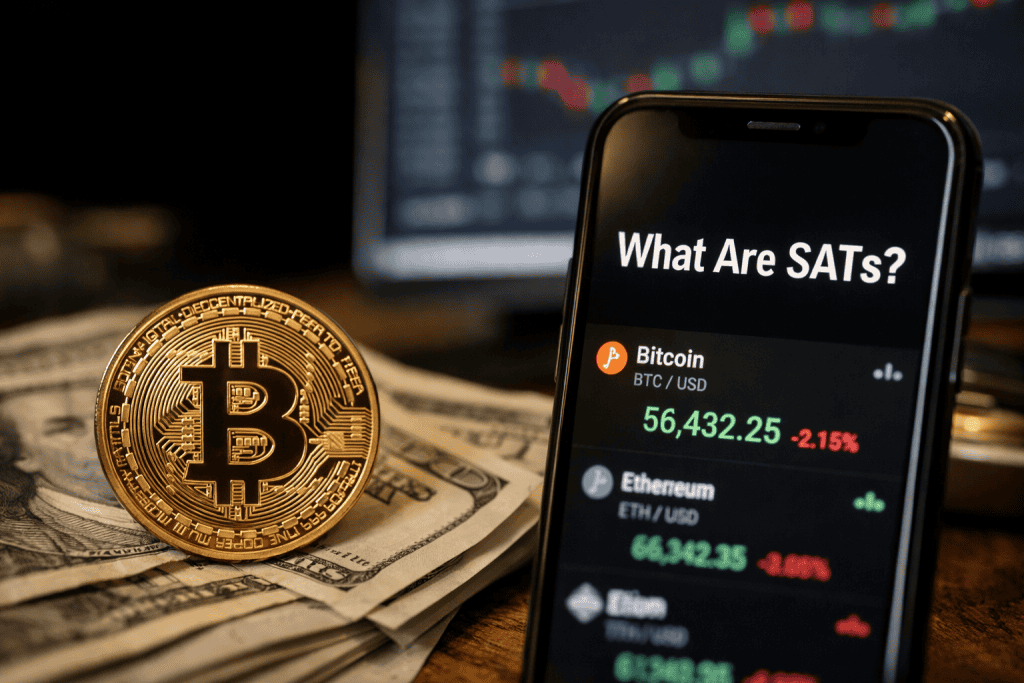
How sats relate to one Bitcoin (BTC) and how to convert between them
| BTC Amount | Satoshis (sats) | Approx. USD Value (Mar 2026) |
|---|---|---|
| 1 BTC | 100,000,000 sats | ~$73,930 |
| 0.1 BTC | 10,000,000 sats | ~$7,393 |
| 0.01 BTC | 1,000,000 sats | ~$739 |
| 0.001 BTC | 100,000 sats | ~$73.93 |
| 0.0001 BTC | 10,000 sats | ~$7.39 |
| 0.00000001 BTC | 1 sat | ~$0.000737 |
Source: Kraken – Satoshi to USD Converter (2026) | Bitbo.io (2026)
Quoting Bitcoin in sats lets you avoid long decimals and convert amounts in seconds, which reduces sending errors and makes prices feel more “normal”. Keep your wallet set to sats for day-to-day use, then convert to BTC only when you need to compare market prices or tax records.
The relationship stays fixed: 1 BTC = 100,000,000 sats. To convert BTC to sats, multiply by 100,000,000. To convert sats to BTC, divide by 100,000,000. For quick mental checks, 0.01 BTC equals 1,000,000 sats, and 0.0001 BTC equals 10,000 sats.
Sats win as a unit of account because most real payments and tips are small fractions of a bitcoin. Saying “25,000 sats” is clearer than “0.00025 BTC”, and it keeps amounts readable as the BTC price moves.
BTC still fits in some places. Exchanges, price charts, and market news often quote BTC, while the Bitcoin Core documentation and many technical tools use BTC or “bitcoin” for standardisation.
Why Bitcoin needs small units for everyday payments and pricing
BTC denomination vs. approximate USD value at ~$73,930/BTC (Mar 17, 2026). Source: CoinDesk BTC Price (2026) — coindesk.com/price/bitcoin
Bitcoin pricing breaks down fast when you rely on whole BTC, because most real amounts become long decimals that are hard to scan and easy to misread.
The network already solves this by tracking balances as whole-number satoshis under the hood. Wallets and exchanges can display BTC for markets, but the ledger moves value in sats, then converts the display for humans. That design keeps arithmetic exact and avoids rounding issues that can appear with floating-point maths.
Small units make everyday payments workable. A coffee, a subscription, or a small online tip can be priced in sats without strings of zeros, and merchants can update prices in small steps as the BTC exchange rate moves. Sats also lower the mental barrier for new users, because owning and spending “thousands of sats” feels more natural than “0.0000… BTC”.
The same unit-of-account habit shows up in mining discussions, where payouts and fees are often quoted in sats; see What Are Bitcoin Mining Pools? for how rewards get split and paid.
How wallets and exchanges show sats (and why you may see different formats)
Most wallets and exchanges store your Bitcoin balance in sats, then convert the display into BTC, sats, or a local currency for readability.
Set a single display format before you send or compare amounts. In your wallet settings, look for “Display unit” or “Bitcoin unit”, then choose sats for day-to-day use. Keep BTC for market charts and reporting, where most price feeds still quote in BTC.
Check the label next to every number before you confirm a send. Some apps show “BTC” in small text, others show a sat symbol or “sats”, and some switch formats as values get larger. If an exchange shows both a crypto amount and a fiat estimate, treat the fiat line as an estimate that moves with the market, not the amount you are sending.
You may also see “mBTC” (millibitcoin) or “bits” in older apps. Those units are valid, but they add another conversion step and can slow you down when you move between platforms.
Common mistakes come from missing decimals and mixed units. Avoid copying an amount shown in BTC into a sats field, or the other way round. Before you hit confirm, re-check the unit label, the number of digits, and the final preview screen.
Why the Bitcoin community prices in sats as a common unit of account
Pricing in sats fixes a common problem: most real-world Bitcoin amounts look like unreadable decimals in BTC. Sats keep numbers in whole units, so people can compare prices and balances quickly without counting zeros. Wallets already track balances in satoshis under the hood, so quoting in sats matches how the network measures value and avoids rounding issues.
Sats also make Bitcoin feel accessible. Saying “50,000 sats” signals a small, spendable amount, while “0.0005 BTC” feels abstract to new users. The unit becomes even more useful when you compare Bitcoin products and market terms, such as what is a spot, where pricing, fees, and holdings often need clear, consistent units.
Frequently Asked Questions
What is a satoshi (sat) in Bitcoin?
A satoshi (sat) is the smallest unit of Bitcoin, equal to 0.00000001 BTC (one hundred millionth of a bitcoin). Sats make tiny payments and fees possible without using long decimals. Wallets and exchanges often show balances in sats to make amounts easier to read.
How many sats are in 1 Bitcoin?
Bitcoin is divisible into smaller units called satoshis (sats). 1 Bitcoin equals 100,000,000 sats. This fixed ratio lets you send and price tiny amounts of Bitcoin.
Why do people quote Bitcoin prices in sats instead of BTC?
Quote prices in sats when the amount is small. It makes values easier to read and compare, since 1 BTC equals 100,000,000 sats. Sats also reduce rounding and avoid long decimals, which helps when discussing everyday payments or fees.
How do sats make Bitcoin easier to use for small, everyday payments?
When a payment is too small to express in whole bitcoins, sats solve the problem. They let you price items in whole numbers, such as 5,000 sats, instead of 0.00005000 BTC. This makes amounts easier to read, compare, and pay accurately without rounding.
Can I buy or hold Bitcoin in sats, and how does that show up in a wallet or exchange?
1 bitcoin equals 100,000,000 sats. Most exchanges let you buy fractions of a bitcoin, so your balance may show as BTC (for example, 0.00025000) or as sats (25,000). Wallets often display sats by default, or let you switch units in settings; the underlying amount stays the same.