
Proof of Work (PoW) and Proof of Stake (PoS) secure blockchains through different incentive models. PoW relies on miners solving computational puzzles, which ties security to electricity and specialised hardware. PoS selects validators based on staked funds, shifting security towards economic penalties and on-chain governance rules. This comparison examines how each model affects attack resistance, energy consumption, and the distribution of rewards and costs across network participants.
Key takeaways
- Proof of Work secures networks through hash power, making attacks energy-intensive.
- Proof of Stake secures consensus by locking capital, penalising misbehaviour via slashing.
- Proof of Work energy use scales with competition for block rewards, not transaction count.
- Proof of Stake typically cuts electricity demand, shifting costs towards capital and custody.
- Proof of Work attack cost depends on hardware and electricity; Proof of Stake depends on stake.
- Proof of Stake introduces validator concentration and governance risks; Proof of Work centralises mining pools.
How Proof of Work and Proof of Stake Validate Transactions
In September 2022, Ethereum completed the Merge and cut network energy use by about 99.95% (Ethereum Foundation). That single change highlights the core difference between proof of work (PoW) and proof of stake (PoS): both validate transactions, but they choose validators in different ways and impose different costs on attackers.
PoW validates transactions through mining. Miners gather transactions into blocks and compete to solve a cryptographic puzzle; the first miner to find a valid solution broadcasts the block, and other nodes verify the work before accepting it. This design ties security to real-world expenditure: an attacker must control a large share of total hash rate and sustain high electricity and hardware costs to rewrite history.
PoS validates transactions by selecting validators based on staked collateral rather than computing power. On Ethereum, a validator stakes 32 ETH to propose and attest to blocks, and the protocol can “slash” (confiscate) part of that stake for provable misbehaviour. This shifts security from energy burn to economic penalties, because an attacker must acquire and risk a large amount of the asset to influence consensus.
Both systems finalise transactions through network-wide verification, but PoW prices security in kilowatt-hours, while PoS prices it in locked capital and explicit penalties.
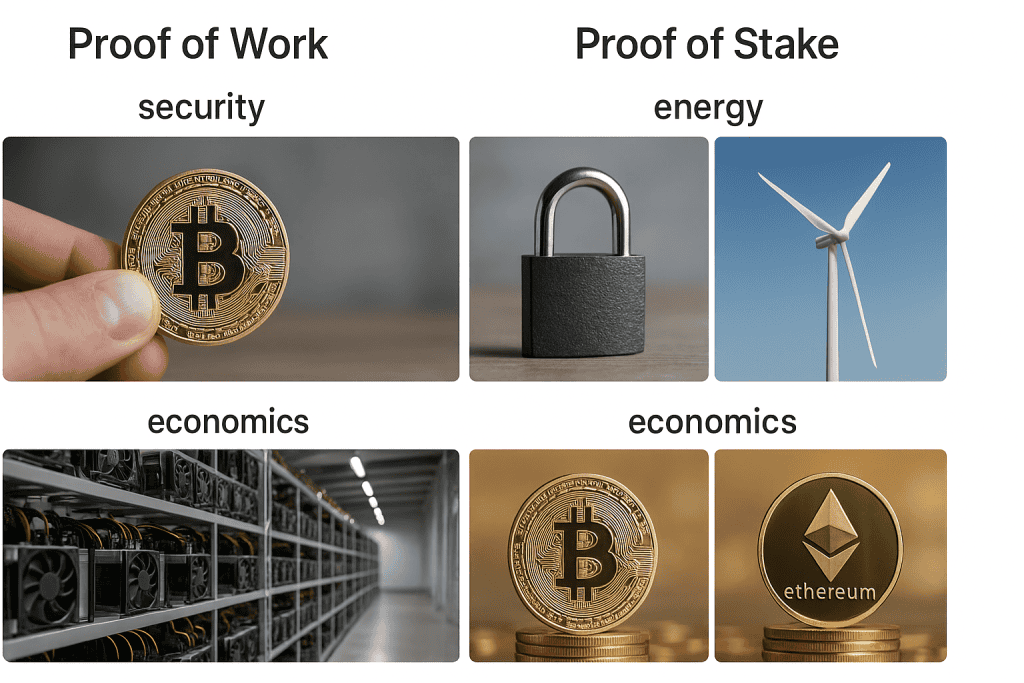
Proof of Work vs Proof of Stake: Security, Energy, and Economics
Security Trade-offs: Attack Costs, Finality, and Slashing
In June 2024, a validator on Ethereum that signs conflicting blocks risks losing staked ETH through slashing, turning an attempted double-sign into a direct, on-chain penalty. That single mechanism illustrates a key PoS security trade-off: the protocol can punish provable misbehaviour, but it must also manage “finality” rules so honest validators converge quickly.
PoW raises attack costs through external spend. An attacker must acquire and run enough specialised hardware and electricity to sustain majority hashpower, and the cost continues for as long as the attack continues. PoS shifts the cost to capital at risk: to control consensus, an attacker must accumulate a large share of stake, then risks burning that stake if the protocol detects equivocation.
Finality changes the economics of reversals. Under PoS, Ethereum’s finality typically arrives in about 12–15 minutes (two epochs), which sharply limits how far a reorganisation can go without extraordinary coordination. Under PoW, confirmations reduce risk gradually, so merchants often wait 6 blocks (about 60 minutes on Bitcoin) for high-value settlement.
Energy and Hardware Footprint: Electricity Use, Emissions, and E-waste
Proof of work (PoW) converts security into continuous electricity demand and specialised mining hardware, while proof of stake (PoS) shifts most costs to capital lock-up and standard server operation. After Ethereum moved to PoS in September 2022, the network cut energy use by about 99.95% (Ethereum Foundation), showing how consensus design can dominate the footprint.
| Factor | Proof of Work | Proof of Stake |
|---|---|---|
| Electricity use | High and continuous; scales with mining competition | Low; mainly validator servers and networking |
| Hardware | ASIC/GPU fleets with shorter replacement cycles | Commodity hardware; fewer performance incentives |
| Emissions driver | Grid mix and miner location | Data-centre power draw, typically marginal |
Practically, PoW networks can externalise costs through power prices and hardware churn, which can raise e-waste when older rigs become unprofitable. PoS reduces energy and hardware pressure, but concentrates risk in key management; a compromised validator key can trigger slashing or loss of funds, so custody choices matter, including hot wallet vs cold wallet security.
Economic Incentives: Issuance, Fees, Staking Yields, and Miner Revenue
Networks fail economically when issuance and fees do not cover security costs. In PoW, miners pay electricity and hardware bills daily, so revenue volatility can cut hash rate within hours. In PoS, validators lock capital, so the main risks shift to yield compression and slashing losses rather than power costs.
PoW aligns incentives by paying miners with block subsidies plus transaction fees; miners reinvest into hash power, raising attack costs. PoS pays validators through issuance and priority fees, while burning can reduce net supply; Ethereum’s EIP-1559 has burned millions of ETH since August 2021 (Ethereum).
Apply this analysis by separating (1) annual issuance rate, (2) fee revenue per block, and (3) required security budget. For PoS, compare staking yield to risk-free rates and estimate the share of supply staked; as of early 2026, Ethereum staking often sits around 3–5% APR, varying with participation (Ethereum). For fee mechanics, review how gas fees work.
When fees rise, both systems fund more security, but PoS can adjust yields without increasing energy use. When fees fall, PoW security can weaken quickly, while PoS tends to degrade more gradually through lower participation.
Decentralisation and Governance: Validator Concentration, MEV, and Censorship Resistance
As of 2026, three entities (Lido, Coinbase, and Binance) each control roughly 10–30% of Ethereum staked ETH, and the largest three together sit near or above 40% depending on measurement method (beaconcha.in). That concentration matters because proof of stake governance power follows stake weight: a small set of operators can shape block production, influence client defaults, and amplify correlated outages.
Maximum Extractable Value (MEV) adds a second centralising force. In 2024–2025, a large majority of Ethereum blocks were built through MEV-Boost relays, which creates chokepoints where a handful of relays can filter transactions or enforce policy (mevboost.pics). Even when validators remain geographically distributed, relay dependence can concentrate censorship risk at the infrastructure layer.
Censorship resistance also depends on who controls validator keys and withdrawal credentials. When users stake through custodial exchanges, operators can comply with sanctions or court orders at scale; when users self-custody, enforcement becomes fragmented and slower. Proof of work faces different pressures, but proof of stake makes governance and transaction inclusion more sensitive to stake and middleware concentration.
Frequently Asked Questions
How does Proof of Work secure a blockchain against double-spending attacks?
Proof of Work prevents double-spending by requiring miners to solve costly cryptographic puzzles to add blocks. Each block links to the previous block’s hash, so rewriting history demands re-mining that block and every successor. An attacker must control over 50% of total hash rate to reliably outpace honest miners and reverse confirmed transactions.
What security assumptions differ between Proof of Stake and Proof of Work when attackers control 51% of resources?
With Proof of Work, a 51% attacker assumes control of majority hashpower and can reorganise recent blocks, enabling double-spends, while paying ongoing electricity and hardware costs. With Proof of Stake, a 51% attacker assumes control of majority staked coins and can censor or rewrite history, but risks slashing and permanent loss of capital.
How do Proof of Work and Proof of Stake compare on electricity use and carbon emissions per transaction?
Proof of Work (PoW) uses far more electricity per transaction because miners run specialised hardware continuously. After Ethereum’s 2022 switch to Proof of Stake (PoS), estimated energy use fell by about 99.95% and associated emissions dropped by a similar margin. PoS transactions typically add negligible extra electricity compared with running validator servers.
What economic incentives and penalties (rewards, fees, slashing) shape validator or miner behaviour in each model?
Proof of Work pays miners block subsidies and transaction fees; miners maximise profit by adding hashpower, but face sunk hardware costs and ongoing electricity bills, often $0.03–$0.10 per kWh. Proof of Stake pays validators issuance and fees proportional to stake; misbehaviour triggers slashing (often 0.5%–100%) and downtime reduces rewards through missed attestations.
How do staking yields, lock-up periods, and validator requirements affect decentralisation in Proof of Stake networks?
High staking yields concentrate stake with large holders and liquid staking providers, reducing validator diversity. Lock-up and unbonding periods (often 7–28 days) raise exit costs, favouring institutions with stable liquidity. High validator requirements (for example, 32 ETH on Ethereum) increase capital barriers, pushing users towards pooled staking and increasing centralisation risk.