
Centralised and decentralised exchanges offer two distinct ways to trade cryptoassets. A centralised exchange operates through a company that matches orders and holds user funds, which can improve speed and support but increases reliance on a third party. A decentralised exchange uses smart contracts, which are self-executing code on a blockchain, to enable peer-to-peer trading without a central custodian. Each model brings clear benefits and practical risks.
Key takeaways
- Centralised exchanges hold user funds and manage trades through an internal order book.
- Decentralised exchanges use smart contracts, so users trade directly from personal wallets.
- Centralised platforms often offer higher liquidity, tighter spreads, and faster trade execution.
- Decentralised exchanges reduce custodial risk but expose users to smart contract vulnerabilities.
- Centralised exchanges usually require identity checks, while decentralised trading can be permissionless.
- Fees differ: centralised exchanges charge trading and withdrawal fees; decentralised swaps include gas costs.
Definitions: Centralised Exchanges (CEX) vs Decentralised Exchanges (DEX)
A centralised exchange (CEX) is a trading platform run by a company that matches buyers and sellers and holds client assets in custodial wallets. Users usually open an account, complete identity checks, and deposit funds before trading. Well-known examples include Coinbase and Binance. Since the operator controls the infrastructure, a CEX can offer fast order matching, customer support, and features such as limit orders. Many platforms also provide fiat on-ramps, which allow deposits in traditional currencies. At the same time, custody creates counterparty risk, since users rely on the platform to safeguard funds and process withdrawals.
A decentralised exchange (DEX) lets people trade directly from their own wallets using smart contracts, which are self-executing programmes on a blockchain. Popular DEX services include Uniswap and Sushi. Trades settle on-chain, so users keep control of private keys and do not need to deposit assets with an intermediary. This structure can improve privacy and reduce reliance on a single operator. However, users must manage wallet security, pay network fees, and accept risks linked to smart contract bugs and price slippage during volatile markets.
Which security risks affect centralised exchanges, and which risks affect decentralised exchanges?
Centralised exchanges face concentrated risks because a single operator controls custody, infrastructure, and access. Attackers often target hot wallets, which remain connected to the internet for withdrawals, and a successful breach can expose large pools of client assets. Phishing and account takeover also remain common, especially when users reuse passwords or fail to enable multi-factor authentication. Operational failures can create further exposure, such as withdrawal halts, insolvency, or internal fraud. Even reputable platforms can suffer outages during market stress, which may prevent timely trades. For context on common attack patterns, see guidance from the UK National Cyber Security Centre.
Decentralised exchanges shift several risks away from a central custodian, yet they introduce different threats. Smart contract bugs can allow exploits that drain liquidity pools or manipulate pricing, and users often cannot reverse transactions once executed. Front-running and other forms of maximal extractable value (MEV) can worsen execution prices when bots reorder transactions. Wallet security also becomes critical, since a compromised private key can result in immediate loss. Network congestion and high fees may increase failure rates for time-sensitive swaps, while fake tokens and malicious approvals can trick users into granting excessive permissions.
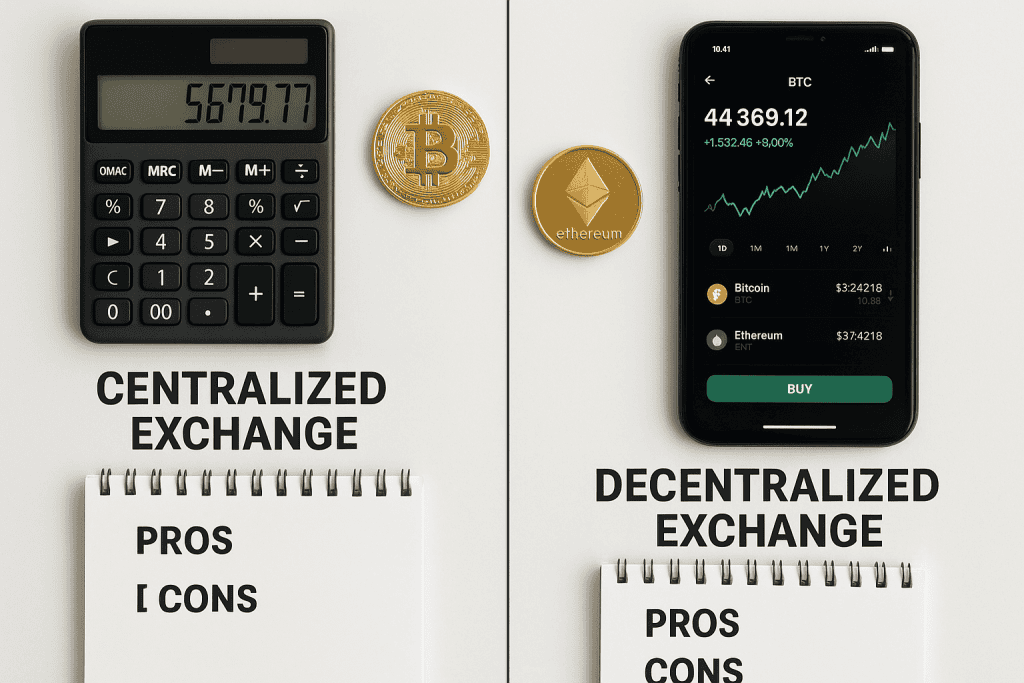
Centralized vs Decentralized Exchanges: Pros & Cons
How do identity checks and privacy expectations differ between centralised and decentralised exchanges?
Centralised exchanges (CEXs) usually require identity checks because the operator acts as a regulated intermediary. Many CEXs apply Know Your Customer (KYC) and Anti-Money Laundering (AML) controls, which can include photo identification, proof of address, and screening against sanctions lists. Regulators set these expectations in many jurisdictions, and exchanges often align with guidance from bodies such as the Financial Action Task Force (FATF). As a result, a CEX account often links trading activity to a verified identity, and the platform may monitor transactions for compliance.
Decentralised exchanges (DEXs) typically allow trading without creating an account, since smart contracts (self-executing code on a blockchain) handle swaps directly between wallets. That design reduces the need for platform-level identity checks. Even so, privacy expectations should remain realistic. Public blockchains record transactions permanently, and blockchain analytics can connect wallet activity to real-world identities when users interact with regulated services or reuse addresses. Some DEX interfaces also restrict access in certain regions or add screening tools, which can change the practical level of anonymity.
- Data collection: CEXs often collect personal data for verification and support; DEXs usually collect less personal data at protocol level.
- Data exposure risk: CEX users face potential data breaches involving identity documents; DEX users face on-chain traceability and wallet-level privacy risks.
- Control and consent: CEXs can freeze accounts or request extra checks; DEX users keep custody, but must manage wallet security and transaction privacy.
For many users, the practical choice comes down to compliance needs versus privacy preferences. A CEX may suit users who want fiat on-ramps and clear regulatory alignment, while a DEX may appeal to users who prefer fewer identity checks and direct wallet-to-wallet trading.
When does a decentralised exchange offer better control of funds than a centralised exchange?
A decentralised exchange can offer better control of funds when a trader needs to keep custody at all times. On a DEX, assets usually remain in a personal wallet until a swap occurs, which reduces reliance on an operator to process withdrawals or maintain access. This structure suits users who want to avoid account freezes, withdrawal queues, or platform outages that can prevent timely transfers during volatile markets.
Control also improves when a user wants to manage security settings directly. A self-custody wallet lets the holder choose how to store private keys, such as using a hardware wallet, and set transaction approvals for each trade. In contrast, a centralised exchange can restrict withdrawals, impose limits, or change policies with little notice, even when the user holds a positive balance.
However, a DEX only provides stronger control when the user can manage key security and transaction checks. Smart contract interactions remain irreversible once confirmed on-chain, and mistakes such as sending funds to the wrong address can lead to permanent loss. Guidance from the Financial Conduct Authority (FCA) highlights that cryptoasset transfers often lack the protections seen in traditional finance, which makes careful wallet management essential.
How do custody and private keys work on centralised exchanges compared with decentralised exchanges?
Custody describes who controls the assets and, crucially, who holds the private keys that authorise transfers on a blockchain. On a centralised exchange, the platform typically holds client assets in custodial wallets and manages the private keys on the user’s behalf. As a result, access depends on the exchange’s account controls, withdrawal policies, and operational resilience. For example, Coinbase and Binance operate custody systems designed to secure pooled funds, often combining offline “cold” storage with limited online “hot” wallets for withdrawals.
On a decentralised exchange, the user usually keeps private keys in a personal wallet, such as MetaMask, and signs transactions directly. A smart contract (self-executing code on a blockchain) then carries out the swap according to the signed instructions. This model improves self-custody, yet it also places responsibility on the user. Seed phrases and private keys must remain secret and backed up securely, because no operator can reset access. Transaction approvals also matter: granting a contract permission to spend tokens can create ongoing exposure if the user approves excessive allowances or interacts with a malicious contract.
Frequently Asked Questions
What is the difference between a centralised exchange (CEX) and a decentralised exchange (DEX)?
A centralised exchange (CEX) is run by a company that holds users’ funds and matches trades through its own systems. A decentralised exchange (DEX) uses smart contracts, which are self-executing code on a blockchain, to enable peer-to-peer trading while users keep control of their wallets and private keys.
What are the main advantages and disadvantages of using a centralised exchange?
A centralised exchange offers high liquidity, fast trades, and user-friendly tools, often with customer support and fiat on-ramps. However, users must trust the operator with custody, which raises hacking and insolvency risks. Central control can lead to account freezes, withdrawal limits, and stricter identity checks, reducing privacy.
What are the main advantages and disadvantages of using a decentralised exchange?
A decentralised exchange lets users trade from a self-custody wallet, which reduces reliance on a central operator and can improve privacy and access. Trades can cost more in network fees, and prices may slip in low-liquidity markets. Users also face smart contract risks, scams, and limited customer support.
How do fees, liquidity, and slippage typically compare between CEXs and DEXs?
CEXs often charge clear trading fees and can offer deep liquidity, which usually reduces slippage on large orders. DEXs may have lower platform fees, yet users pay network gas fees and liquidity provider fees. Liquidity varies by pool, so slippage can rise on thin pairs, especially during volatility.