
Staking and yield farming both offer ways to earn returns from crypto assets, yet they work in different ways and carry different risks. Staking typically involves locking tokens to support a blockchain network and receiving rewards for that support. Yield farming usually involves moving assets between decentralised finance protocols to earn fees, incentives, or interest. This comparison explains how each approach works, what affects returns, and which option may suit different risk levels and time commitments.
Key takeaways
- Staking locks tokens to support a blockchain and earns predictable protocol rewards.
- Yield farming supplies liquidity to decentralised finance pools, with returns that fluctuate.
- Staking risk centres on validator performance and token price volatility during lock-ups.
- Yield farming adds smart contract risk and impermanent loss when pool prices diverge.
- Staking suits longer-term holders seeking simpler management and steadier yields.
- Yield farming suits active users who can monitor pools and adjust positions frequently.
Key Differences Between Staking and Yield Farming
Staking and yield farming both aim to generate returns from cryptoassets, yet they work in distinct ways. Staking locks tokens in a proof-of-stake network to help validate transactions and secure the blockchain. In exchange, the network pays rewards, often at a predictable rate. Many platforms present staking as a simpler option because it usually involves fewer moving parts and clearer reward schedules. Some services also offer flexible terms, although returns may vary by validator performance and network conditions.
Yield farming, by contrast, allocates assets across decentralised finance protocols to earn fees, incentives, or interest. A common approach places tokens into liquidity pools on automated market makers, where traders pay fees to swap assets. Returns can rise quickly during high demand, yet they can also fall as incentives change or as more capital enters a pool. Strategies often require active monitoring, since rates and token rewards can shift without notice.
Risk profiles differ. Staking exposes holders to price volatility and, on some networks, “slashing” penalties for validator misbehaviour. Yield farming adds smart contract risk and impermanent loss, which can reduce value when pooled token prices move apart. For baseline definitions and security concepts, see Ethereum.org and Coinbase. Each approach suits different time horizons, risk tolerance, and liquidity needs.
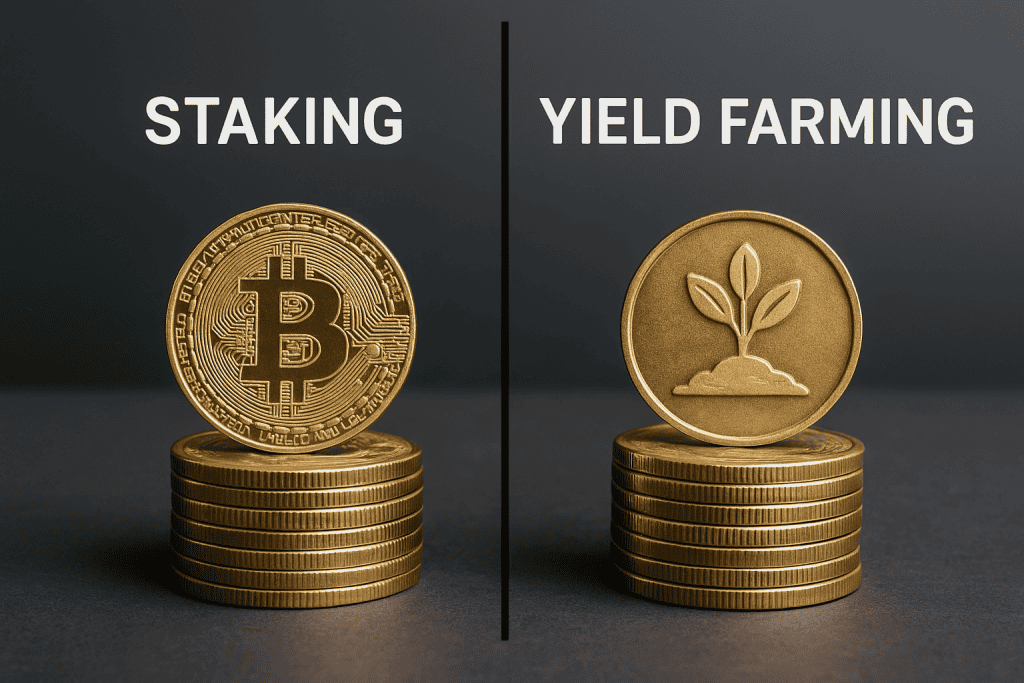
Staking vs Yield Farming
How Staking Works: Proof-of-Stake Rewards, Lock-ups, and Validators
Staking lets a proof-of-stake network select participants to propose and verify new blocks. When a user stakes tokens, the protocol treats that balance as economic security. Validators run software that signs blocks and votes on the valid chain, while delegators assign stake to a validator without operating infrastructure. Many networks distribute rewards from new token issuance and transaction fees, then share those rewards with stakers after deducting any validator commission.
Lock-ups vary by protocol. Some chains enforce a fixed bonding period, while others allow flexible staking but apply an unbonding delay before funds become transferable. During that time, the stake still backs the validator, which reduces the chance of sudden exits that could weaken security. Networks also apply slashing, which means the protocol can cut a portion of staked funds if a validator acts dishonestly or stays offline for extended periods.
Reward rates change with network conditions such as total stake, inflation settings, and fee activity. For a clear reference point, Ethereum.org explains how staking supports consensus and how rewards and penalties work in practice.
How Yield Farming Works: Liquidity Pools, Incentives, and Token Emissions
Yield farming generates returns by supplying cryptoassets to decentralised finance (DeFi) protocols that need liquidity. Most strategies use liquidity pools, which are smart contracts that hold two or more tokens so traders can swap assets without a central intermediary. When a user adds funds, the protocol issues liquidity provider (LP) tokens that represent a share of the pool. Trading activity then produces fees, and the pool distributes those fees to LP token holders in proportion to their share.
Protocols often increase participation with incentives. A platform may pay extra rewards to LPs who stake LP tokens in a separate contract, which is sometimes called a “farm”. These rewards frequently come from token emissions, meaning the protocol mints and distributes new tokens on a schedule. Emissions can raise headline yields, yet the value of the reward token can fall if supply grows faster than demand.
Returns also depend on pool conditions. Price changes between pooled assets can create impermanent loss, which reduces value compared with simply holding the tokens. For a practical reference on automated market makers and liquidity pools, see Uniswap Docs.

Proof-of-Stake Rewards
Risk Profile Comparison: Smart Contract Risk, Market Volatility, and Slashing
Staking and yield farming expose participants to different risks, even when headline returns appear similar. Staking centres on protocol rules and validator behaviour. Many proof-of-stake networks apply slashing, which means the protocol can reduce staked funds if a validator breaks rules or remains offline. Delegators can share that penalty, so validator selection and uptime matter. Lock-up periods can also increase exposure to market volatility because tokens may not be immediately withdrawable during price swings.
Yield farming relies heavily on smart contracts, which are self-executing programmes that hold and move funds. A bug, exploit, or flawed economic design can cause sudden losses, even if token prices stay stable. DeFi positions also face sharper market volatility through liquidity pool dynamics, including impermanent loss when paired assets move out of sync. For context on contract and DeFi risks, see guidance from the Financial Conduct Authority (FCA).
Return Potential and Cost Factors: APY, Fees, Impermanent Loss, and Taxes
Return potential often looks higher in yield farming, yet headline APY (annual percentage yield) can mislead. Many DeFi protocols quote APY that assumes frequent compounding and stable incentives, even though token emissions can fall quickly as participation rises. Staking rewards usually change more slowly because networks set issuance and fee distribution through protocol rules, so expected returns often feel easier to model.
Costs can narrow the gap. Stakers may pay validator commission and, on some networks, face withdrawal delays that create an opportunity cost when markets move. Yield farmers often pay swap fees, pool entry and exit fees, and blockchain transaction fees. On networks with high congestion, transaction fees can erase smaller gains.
Impermanent loss also affects yield farming. When prices of pooled tokens diverge, the pool rebalances, which can leave a liquidity provider with less value than simply holding the tokens. Staking does not carry impermanent loss, although token price moves still affect real-world returns.
Tax treatment varies by jurisdiction, so professional advice helps. In the United Kingdom, guidance from HM Revenue & Customs (HMRC) indicates that staking and DeFi rewards may create income and capital gains events, depending on the facts and the transaction structure.
Liquidity and Time Horizon: Unstaking Delays, Withdrawal Rules, and Flexibility
Liquidity often decides which approach suits a portfolio. Many staking systems impose an unbonding period, so funds remain illiquid after a user requests to unstake. Some networks also apply withdrawal queues or epoch-based exits, which can delay access during high demand. Liquid staking tokens can improve flexibility, yet those tokens can trade at a discount in stressed markets.
Yield farming usually allows faster exits because liquidity provider positions can be removed at any time, subject to pool rules and network congestion. Even so, some protocols add timelocks, withdrawal fees, or reward vesting to discourage short-term capital. Before committing funds, review the specific contract terms and the chain’s settlement speed. For a longer time horizon, predictable lock-ups may feel acceptable; for short-term needs, prioritise strategies with clear, rapid redemption paths. Guidance on staking withdrawals and lock-ups appears in the Ethereum staking documentation.
Practical Selection Criteria: Asset Type, Platform Trust, and Risk Tolerance
Start with the asset type. Native proof-of-stake coins usually suit staking because the network pays rewards for securing consensus. By contrast, yield farming often relies on pairs of tokens in a liquidity pool, so stablecoins and widely traded assets tend to fit better. If a token has thin liquidity or extreme price swings, farming returns can evaporate even when the quoted rate looks attractive.
Next, assess platform trust. For centralised providers, check licensing, custody model, and proof-of-reserves disclosures where available. For decentralised protocols, prioritise transparent documentation, long operating history, and independent security audits. Audit reports do not remove risk, yet they help identify known weaknesses. Use primary sources such as Ethereum for protocol basics and Chainlink for common DeFi infrastructure.
Risk tolerance should set position size and complexity. Conservative profiles often favour simpler reward paths and fewer dependencies. Higher-risk profiles may accept variable incentives, smart contract exposure, and active monitoring. Before committing funds, define exit rules, acceptable drawdown, and a plan for fees and tax reporting in the relevant jurisdiction.
Common Use Cases and Example Scenarios for Different Investor Goals
Different goals call for different structures. The examples below show how staking and yield farming can fit common investor aims without repeating the mechanics already covered.
- Goal: steady, lower-maintenance income from a long-term holding. A holder of a proof-of-stake coin may prefer staking to earn protocol rewards while keeping exposure to a single asset. This approach often suits investors who want fewer moving parts and who can tolerate an exit delay.
- Goal: keep capital relatively stable while earning fees. A stablecoin-focused yield farming strategy can suit an investor who prioritises reduced price swings. For example, supplying two stablecoins to a large decentralised exchange pool may generate fee income, although smart contract risk and changing incentives still apply. Market data and pool composition tools from DeFiLlama can help track liquidity and yields across protocols.
- Goal: maximise returns with active monitoring. An experienced participant may rotate between farming opportunities as incentives change, rebalance positions, and harvest rewards on a schedule. This style fits investors who accept operational complexity, higher fee sensitivity, and the need for frequent checks.
- Goal: maintain flexibility while earning staking-like rewards. Liquid staking can suit an investor who wants staking exposure while retaining a tradable token. For instance, Lido issues liquid staking tokens on supported networks, which can then be used across DeFi. Price discounts can appear during stress, so liquidity and market depth matter.
- Goal: test the waters with limited downside. A small allocation to either approach can help an investor learn platform workflows, fee patterns, and reporting needs before scaling. Clear record-keeping supports tax reporting; guidance from HM Revenue & Customs provides a useful starting point for UK taxpayers.
Practical fit often matters more than headline APY: match the strategy to the time horizon, monitoring capacity, and tolerance for complexity.
Frequently Asked Questions
What is staking in crypto, and how do staking rewards work?
Staking in crypto means locking tokens to help run a proof-of-stake blockchain and validate transactions. In return, the network pays staking rewards, usually in the same token. Rewards depend on the staking rate, validator performance, network rules, and any fees. Some platforms also impose lock-up periods and slashing penalties for misconduct.
What is yield farming, and how do liquidity pool rewards get calculated?
Yield farming involves providing crypto assets to decentralised finance protocols to earn returns. Liquidity pool rewards usually come from trading fees and incentive tokens. Protocols calculate payouts by your share of pool liquidity and the pool’s fee rate, then distribute rewards per block or time period. Returns vary with volume, token prices, and pool size.
How do the risks of staking compare with the risks of yield farming, including smart contract risk and impermanent loss?
Staking usually carries lower risk, mainly price volatility, validator slashing, and lock-up limits. Yield farming often adds higher smart contract risk (code exploits), protocol and liquidity risk, and impermanent loss, where pool rebalancing reduces value versus holding. Returns can change quickly, so losses may exceed staking outcomes.
Which option usually offers more predictable returns: staking or yield farming?
Staking usually offers more predictable returns because protocols often set or signal reward rates and payouts follow a clearer schedule. Yield farming tends to be less predictable, as returns change with trading fees, token incentives, liquidity shifts, and price volatility. Even with staking, returns can vary due to network conditions and slashing risk.
How do lock-up periods, withdrawal times, and liquidity differ between staking and yield farming?
Staking often uses fixed lock-up periods or unbonding times, so withdrawals can take days or weeks and liquidity stays limited. Yield farming usually keeps funds liquid through liquidity pools, enabling faster withdrawals. However, liquidity can drop if pool depth falls, and some farms add time-locked rewards or exit fees.
What fees and tax considerations can affect staking and yield farming returns in the United Kingdom?
Returns can fall due to network gas fees, validator or pool commissions, platform withdrawal charges, and slippage from price changes. In the United Kingdom, HMRC may treat staking and yield farming rewards as income when received, with Capital Gains Tax on later disposals. Keep records of dates, values, and fees.