
Flare vs Songbird often confuses new users because both networks share similar technology but serve different roles. This guide explains SGB vs FLR by focusing on purpose, risk, and where each token is used across apps and network features.
If you are asking what is Songbird, it acts as a canary network where new changes can be tested before reaching Flare. Flare targets wider, more stable use, while Songbird carries higher change risk and faster experimentation.
Key takeaways
- Flare targets cross-chain data and smart contracts; Songbird runs as its live test network.
- FLR supports core network functions, including fees, staking, and governance decisions.
- SGB is used to trial upgrades, dApps, and economic changes before Flare deployment.
- Songbird typically carries higher risk because features can change or break during testing.
- Flare aims for broader production use, while Songbird suits experimentation and early adopters.
- Projects often launch on Songbird first, then migrate to Flare after stability improves.
Flare (FLR) vs Songbird (SGB): Quick Definitions and How the Networks Relate
In August 2024, Flare reported 2.5 billion FLR staked, with 65% of the circulating supply delegated to validators. Those figures matter because Flare secures the network through delegation, and high participation can raise the cost of attacks while improving validator incentives. It can also reduce the influence of a small set of large holders.
Flare (FLR) is the main network and the token used for core actions such as paying fees and taking part in governance. Songbird (SGB) is a separate network that Flare positions as a canary network, where new features can be tested under real economic conditions before they reach Flare. This relationship explains why people often compare SGB vs FLR when asking where risk sits. It also helps explain why updates often appear on SGB first.
Flare launched its public token distribution in January 2023, while Songbird went live earlier as a proving ground. Both networks use the same broad design goal: bring external data on-chain through Flare’s oracle system, which supports decentralised apps that need price and event data. In practice, Songbird can carry higher change risk because upgrades tend to land there first, while Flare prioritises stability for production use. That split can affect how users plan testing, staking, and app launches.
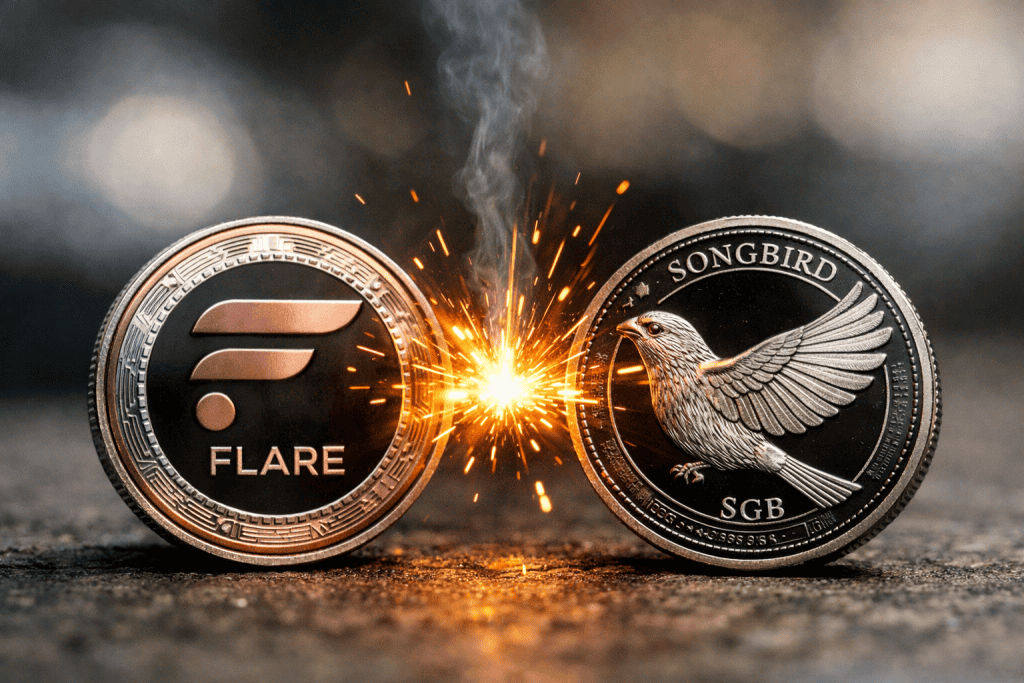
Purpose and Design Goals: Production Utility (FLR) vs Canary Testing (SGB)
A DeFi team wants to launch a lending app that relies on Flare’s on-chain data feeds. The team can deploy straight to Flare using FLR, but a safer path is to run the same contracts on Songbird first. Songbird acts like a live rehearsal: the app meets real users, real liquidity, and real market stress before the team commits to production.
That split explains the core difference in Flare vs Songbird. Flare (FLR) targets long-term utility and stability. Projects use FLR for core network actions such as paying transaction fees and interacting with production-grade protocols. Songbird (SGB) targets fast iteration. Teams use SGB to test upgrades, governance changes, and new protocol designs in conditions that feel “mainnet-like”, but with a higher tolerance for breakage.
| Attribute | FLR (Flare) | SGB (Songbird) |
|---|---|---|
| Network Role | Production mainnet | Canary / testing network |
| Total Token Supply | ~100 billion FLR | ~15 billion SGB |
| Community Allocation | 58% of total supply | Distributed to XRP holders |
| Launch Date | January 2023 (TDE) | September 2021 |
| Oracle Update Speed | Every 1.8 sec (FTSOv2) | Tested on SGB first |
| 6-Month Price Change | –51% | –137.6% |
| Primary Use | Fees, staking, governance, DeFi | Testing, governance, dev sandbox |
Source: WalletInvestor — FLR vs SGB Comparison (2025); Bitstamp — What is Flare Network (2024)
In practice, SGB vs FLR often looks like staging versus production in software. A bug on Songbird can still cost money, but the network exists to surface those failures earlier. When a change proves reliable on Songbird, developers can port the design to Flare with more confidence.
- FLR: production network utility, predictable execution, long-term integrations.
- SGB: canary network testing, faster change cycles, higher experimentation risk.
If you are asking “what is Songbird”, treat it as the proving ground that helps protect Flare’s production environment.
Where Each Token Is Used: Fees, Staking, Governance, and On-Chain Services
FLR token allocation at genesis: 58% to the community, 19% to the team/advisors/backers, and 22.5% to Flare-associated funds. All transaction fees are burned.
FLR is the production token on Flare, while SGB is the live-test token on Songbird. On Flare, users pay network fees in FLR and use FLR for core on-chain actions, including delegation for network security and participation in governance processes. On Songbird, users pay fees in SGB and use SGB for the same categories of actions, but in an environment designed to accept higher change risk.
The key difference is not the menu of features, but the reliability target. Flare aims for stable, long-lived services, so FLR-backed activity tends to suit apps that need predictable execution and user trust. Songbird prioritises rapid iteration, so SGB-backed activity often suits teams testing upgrades, new contracts, or parameter changes before promotion to Flare.
In practice, FLR fits day-to-day use and longer-term positions, while SGB fits experimentation where outcomes can shift quickly. For network context, see Flare and Songbird.
Risk Profile and Volatility Drivers: Why SGB Typically Carries Higher Experimental Risk
FLR has a 100B total supply vs SGB's 15B; 35.5B FLR is actively staked or delegated, underscoring FLR's deeper network participation relative to SGB's experimental role.
Source: Bitcoin Ethereum News — Flare Staking Milestone (2025); Medium — SGB Ascending (2025)
Most losses in test-first crypto networks come from unexpected change: a parameter update, a new contract version, or a data feed tweak that shifts prices and liquidations within minutes. That risk tends to be higher on Songbird because it exists to trial upgrades under real market conditions, while Flare aims for steadier production behaviour.
The practical solution is to treat SGB exposure as experimental capital. Use Songbird to validate contract behaviour, fee costs, and oracle-driven actions before you size positions on Flare.
- Cap position size on SGB and avoid leverage until you have observed at least one upgrade cycle.
- Track network change announcements via Flare and Songbird official channels before interacting with high-risk apps.
- Use strict transaction hygiene: small test transactions, clear slippage limits, and separate wallets for testing versus long-term holdings.
When you follow this approach, SGB becomes a controlled environment for finding failure points early. That reduces the chance that a single upgrade or market shock forces costly, rushed decisions on production positions.
How to Choose Between FLR and SGB for Learning, Building, or Holding
In August 2024, Flare reported 2.5 billion FLR staked, with 65% of circulating supply delegated. That level of participation signals deeper day-to-day use and a stronger security budget, which often suits people who want to learn core mechanics or hold a token tied to production activity.
Choose FLR when the goal is to practise delegation, pay fees on the main network, or build for end users who expect stability. FLR exposure aligns with the chain that aims to keep rules and parameters predictable, so app behaviour stays consistent across weeks and months.
Choose SGB when the goal is to learn by testing upgrades early, trial new contracts, or explore features before they reach production. Treat SGB as higher-change capital: even small updates can shift outcomes fast, and that can amplify short-term swings. For most users comparing SGB vs FLR, a practical split is to hold FLR for long-term participation and keep SGB positions smaller and purpose-led.
Frequently Asked Questions
What is the main purpose of the Flare (FLR) network compared with Songbird (SGB)?
In Flare vs Songbird, Flare (FLR) is the main network built for long-term use, aiming to bring smart contracts and decentralised data to assets from other chains. Songbird (SGB) is a canary network used to test upgrades and new features under real conditions before they reach Flare. SGB vs FLR mainly differs in risk and stability.
How does Songbird (SGB) function as a canary network, and what does that mean for users?
Songbird (SGB) works as Flare’s canary network: a live test chain where new features, upgrades, and economic changes run first under real market conditions. This helps Flare reduce rollout risk. For users comparing Flare vs Songbird (SGB vs FLR), what is Songbird means higher volatility and breakage risk, but earlier access to new tools and rewards.
What are the key risk differences between holding or using FLR versus SGB?
In Flare vs Songbird, SGB vs FLR risk differs by network role. SGB is Songbird’s canary network, so upgrades and tests can cause higher volatility, bugs, and breaking changes. FLR runs on Flare’s main network, so changes tend to be more controlled. Both tokens still face smart contract risk, validator issues, and market price swings.
Where is the FLR token used within the Flare ecosystem, such as governance, fees, or data access?
Within Flare, FLR is used for network fees (gas) when sending transactions and running smart contracts. FLR also supports governance, where holders can vote on protocol changes. Users can delegate FLR to data providers to access decentralised price and event data through Flare’s on-chain oracles, which helps secure accurate data feeds.
Where is the SGB token used on Songbird, and how do common use cases differ from FLR?
SGB is used on Songbird to pay transaction fees, secure the network through staking, and vote in governance. Developers also use SGB to test decentralised apps and protocol upgrades before deployment. In Flare vs Songbird terms, SGB vs FLR differs because FLR targets production use on Flare, while SGB supports higher-risk experimentation and early feature rollout.